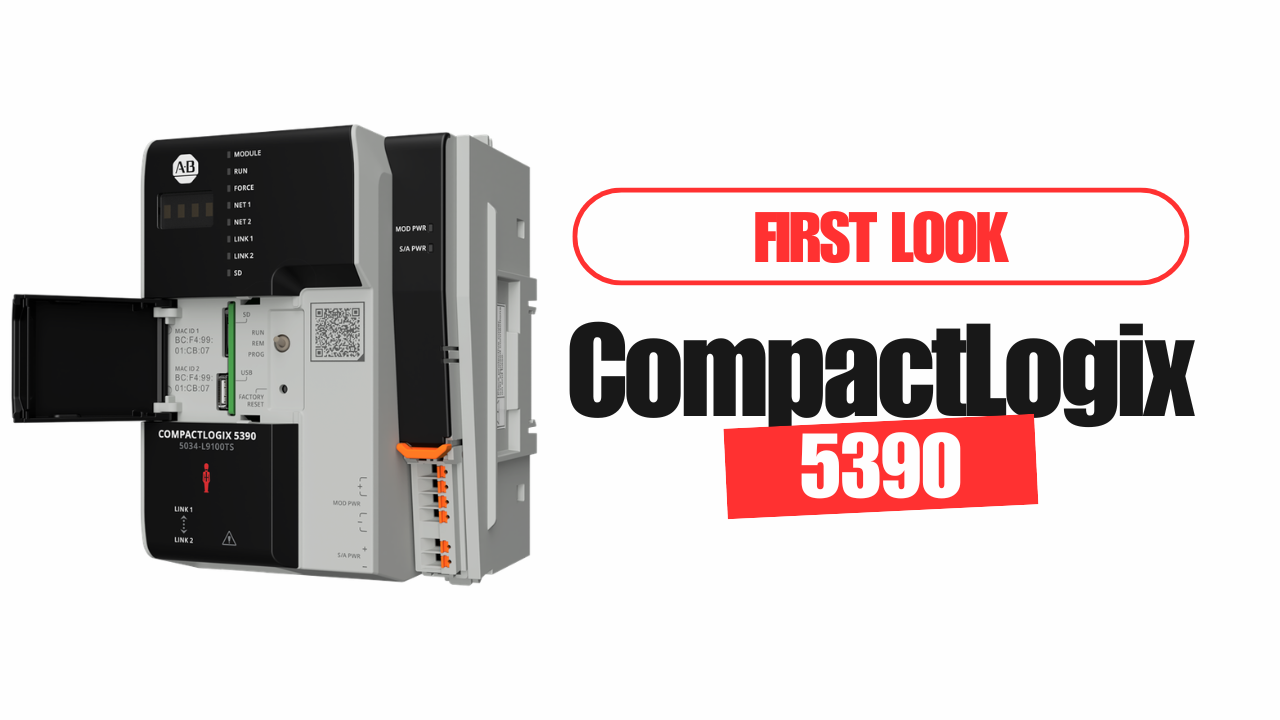
Rockwell Automation has announced the next generation of CompactLogix controller: the CompactLogix 5390.
In this post, I’ll walk you through the features and functions of this new series of controllers.
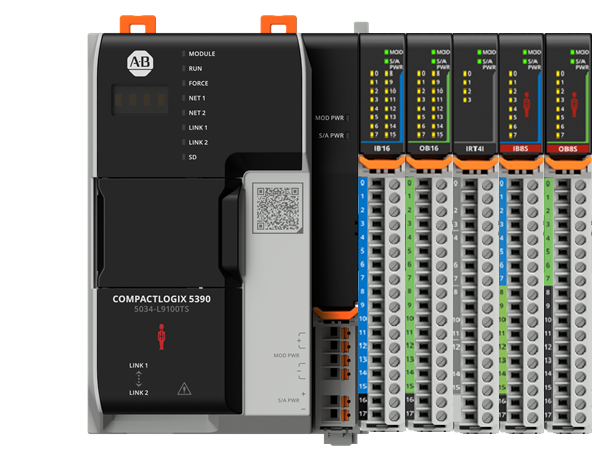
Let’s start by looking at the physical features.
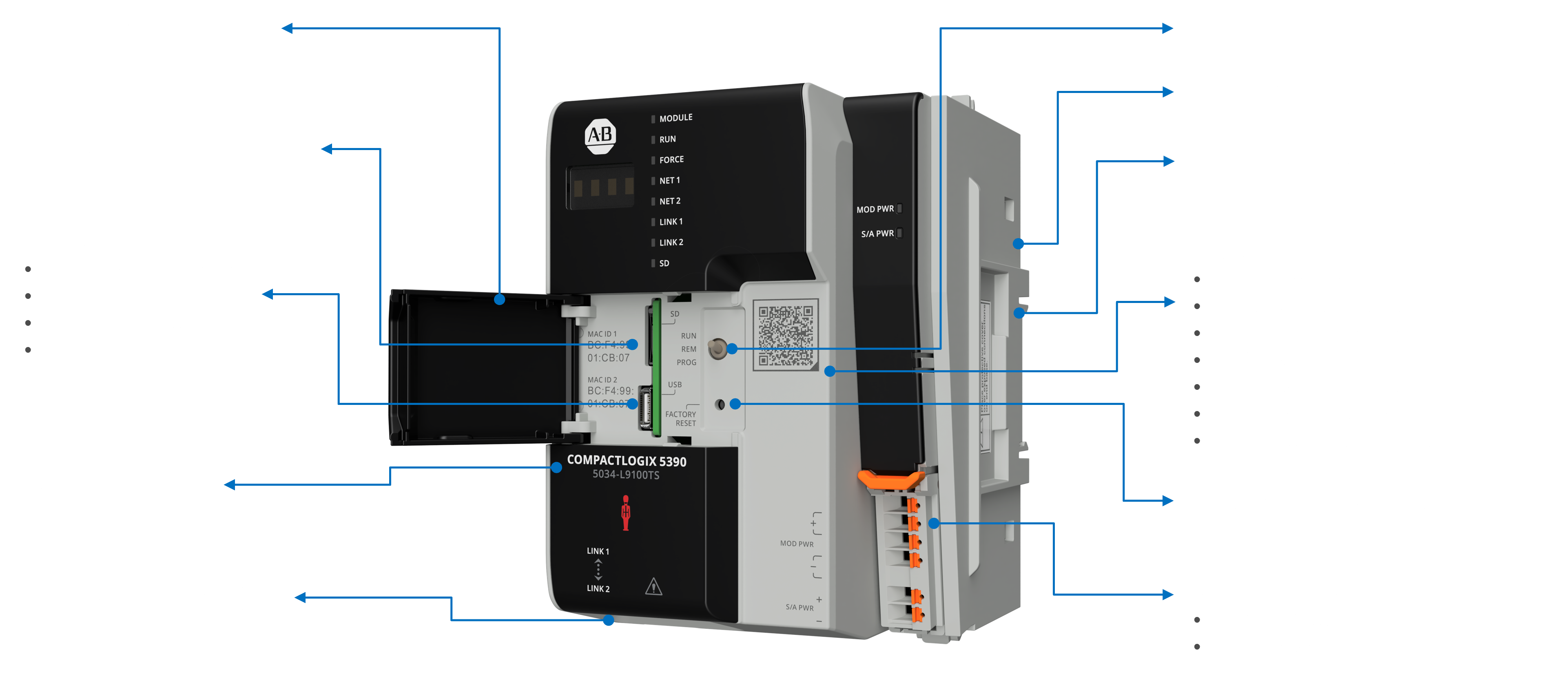
The CompactLogix 5390 has had a major design refresh that includes the introduction of:
Outside of these changes, the design looks quite familiar - there is an access door, two EtherNet/IP ports, a mode switch, an end cap, a factory reset button, and a removable RTB for power.
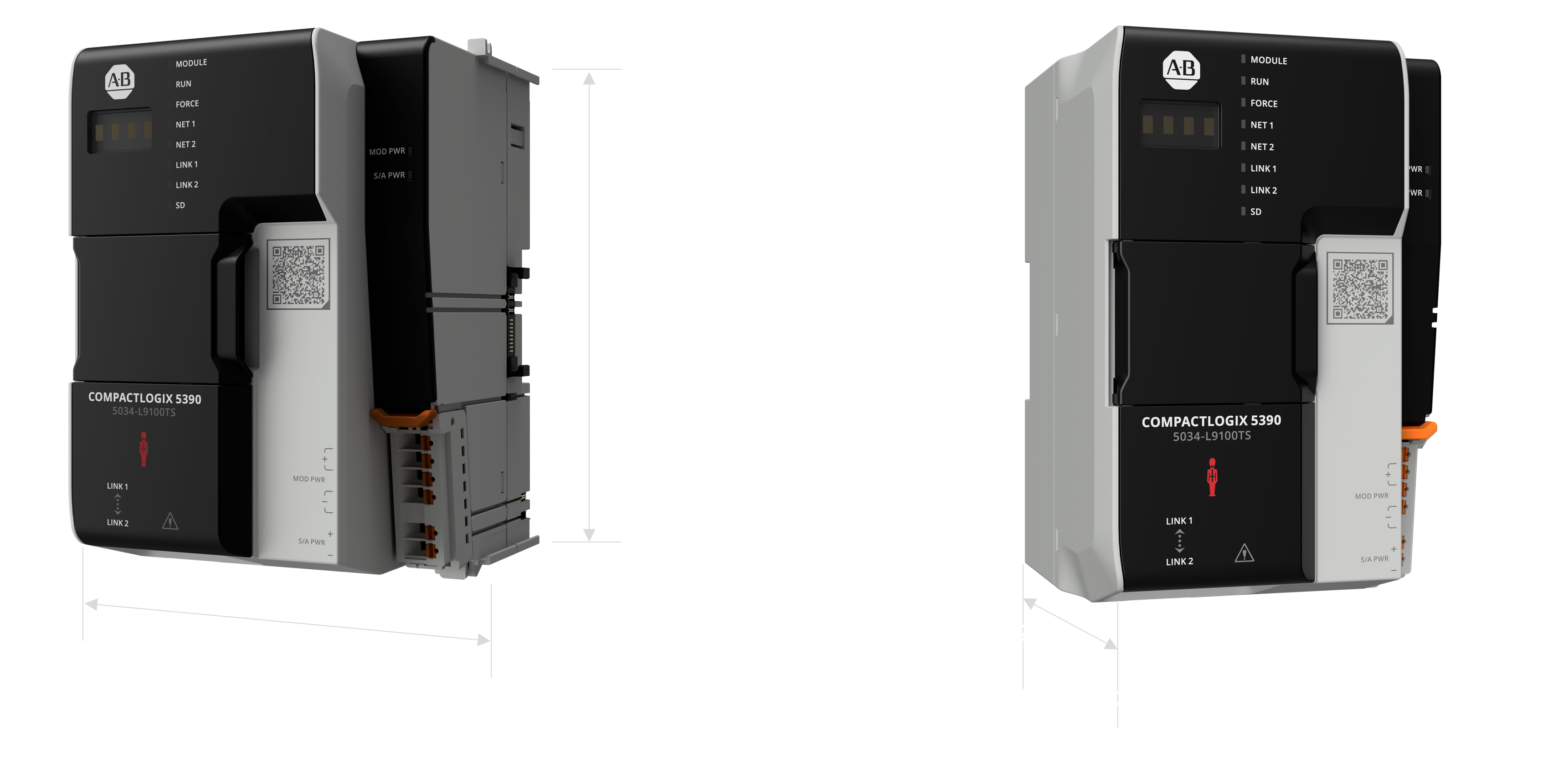
One thing to note is that the CompactLogix 5390 is significantly smaller than its predecessor, the CompactLogix 5380. The height x width x depth of the CompactLogix 5390 is 125 mm (4.92 In) x 85 mm (3.34 In) x 95 mm (3.74 In). This is a 48% reduction in the volumetric space taken up by the controller.
Although this PLC takes up a small amount of space, it is a beast when it comes to performance.
The CompactLogix 5390 massively outperforms the CompactLogix 5380 with Rockwell reporting an estimated:
Beyond raw performance improvements, the CompactLogix 5390 is designed with the latest cybersecurity requirements in mind and complies with cybersecurity requirements laid out in IEC 62443-4-2 and the Cyber Resiliency Act (CRA). It does this through support for CIP security and syslogs.
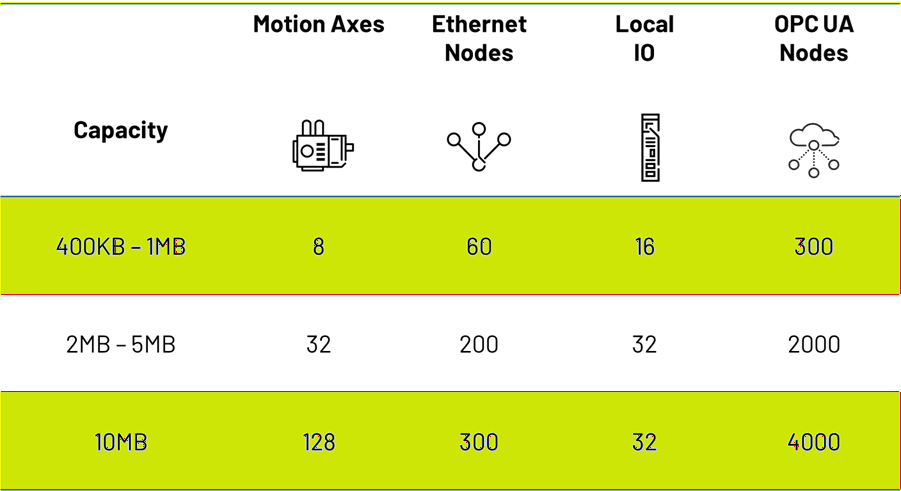
Finally, the CompactLogix 5390 brings performance improvements in terms of connectivity. The high-end CompactLogix 5390 controller supports up to 128 axes of motion, up to 4000 OPC UA nodes, and up to 32 local I/O modules.
Speaking of local I/O modules, ever since the 5034 PointMax IO platform was launched, there were rumours that the next generation of CompactLogix would use 5034 IO for local IO.
These rumours have now been confirmed:
The CompactLogix 5390 can use any 5034 IO modules as local IO, including specialty and partner modules like the 5034-IOL4 IO-Link Master module.
With the introduction of the CompactLogix 5390, Rockwell Automation has taken the opportunity to consolidate the number of SKUs that are available.
They have done this by making every CompactLogix 5390 controller support motion and safety. So, instead of having to select between a 5069-L310ER, 5069-L310ERS2, 5069-L310ERM, or a 5069-L310ERMS2, you will order a 5034-L9010TS and choose if you want to use the safety and motion capabilities.

The actual capabilities of the individual controllers in the product line scales with the controller’s memory and ranges from 8 to 128 axes of motion, 60 to 300 ethernet nodes, 16 to 32 local IO modules, and 300 to 4000 OPC UA nodes.
The exact breakdown is shown in the table here.
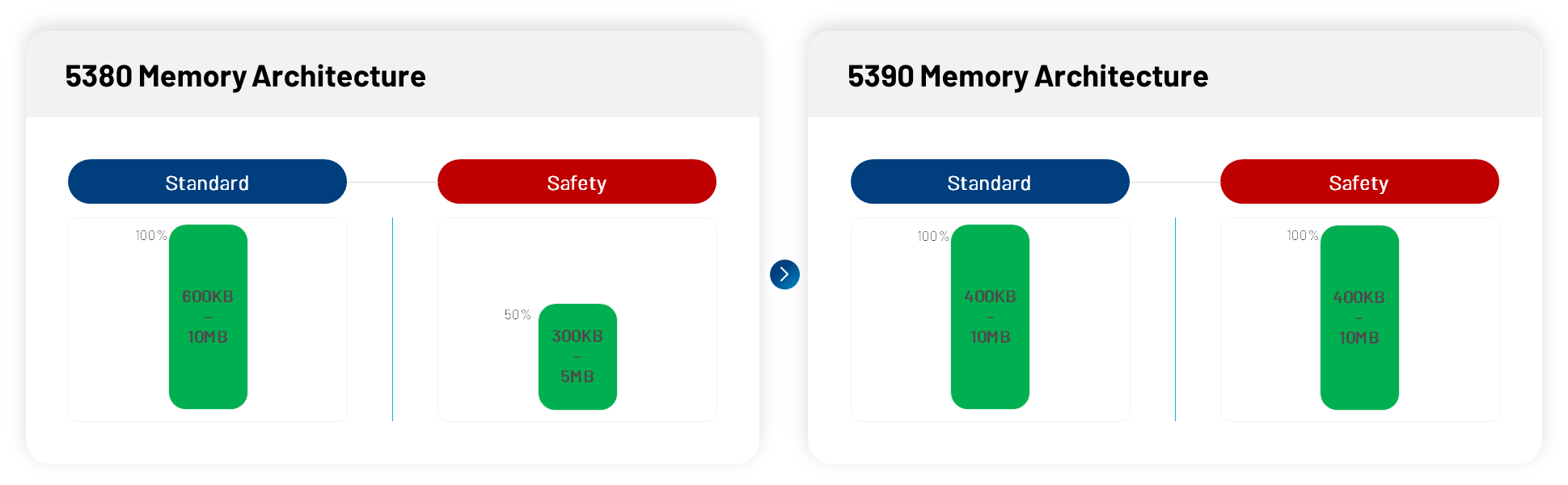
Since we’re talking about memory, it’s also important to note that the memory architecture of the controller has changed. CompactLogix 5390s can use 100% of the available memory for safety. In CompactLogix 5380s, this was limited to 50% of the controller’s memory.
When I was talking about consolidated SKUs, I gave an example of a CompactLogix 5390 part number. If you were paying attention, you may have noticed that it is very different from CompactLogix 5380 part numbers.
That’s because Rockwell has redesigned the catalog numbers to provide at a glance understanding. The breakdown of the catalog number is shown here. As you can see, it’s now easier to identify the memory capacity of the controller from the part number.
In this post, I introduced you to the new CompactLogix 5390 controllers. If I had to summarize this new product line from Rockwell in a few words, I would say “smaller, simpler, more powerful”.
The smaller footprint is ideal for space-constrained applications, the reduced SKUs makes it easier to select a controller for a specific application and stock spares, and the improved performance makes it ideal for challenging mid-range applications.
I’m looking forward to getting my hands on one in 2027.
Get new content delivered straight to your inbox:
.png)